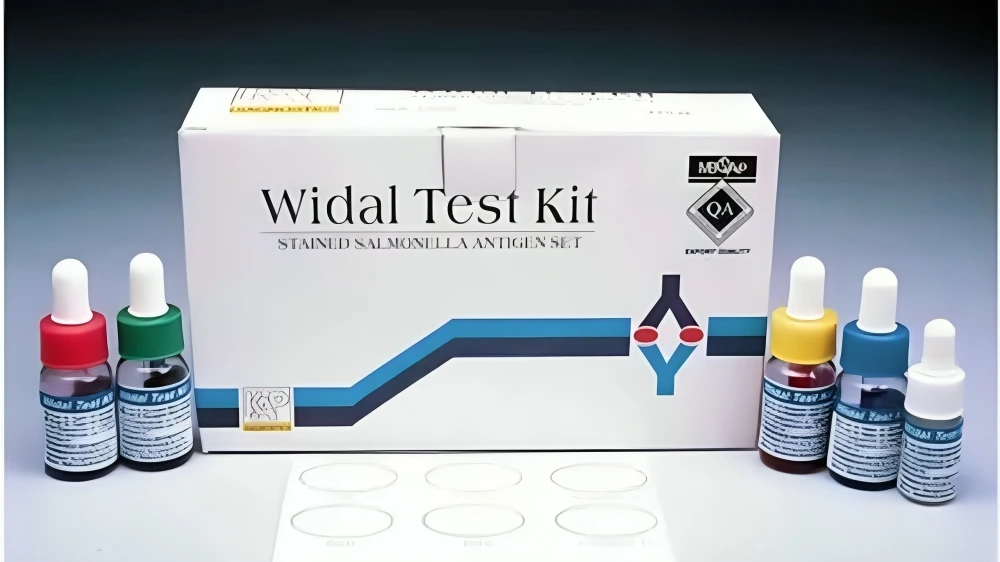
One of the oldest and most commonly used diagnostic tools used to diagnose typhoid fever is the Widal test. This test is still a significant initial step in diagnosis, even in several places on earth where typhoid is prevalent today. However, one of the most important difficulties about the Widal test is interpretation of the numbers. widal test 1:80 means is a common outcome that people frequently request. What does it mean? Is it a confirmation of typhoid or simply an indication of a previous exposure?
The truth is that interpreting a Widal test at 1:80 is not always straightforward. The meaning can change depending on where you live, whether typhoid is common in your area, your symptoms, and even other infections you might have. In this article, we will explain everything about the Widal test, its procedure, and most importantly, what Widal test 1:80 means in simple words.
What is the Widal Test?
The Widal test is a blood test used to check for typhoid fever. Typhoid is caused by a bacterium called Salmonella Typhi. When a person gets this infection, their body produces antibodies to fight the bacteria. The Widal test works by mixing a patient’s blood serum with special antigens related to typhoid bacteria. If antibodies are present in the blood, the mixture clumps together. This clumping, also known as agglutination, is then measured in numbers called titers.
The titer is presented in the form of a ratio, like 1:20, 1:40, 1:80, 1:160 and the like. The more there are, the greater the presence of antibodies. But the possession of antibodies does not necessarily imply your present illness is typhoid fever. It can sometimes only indicate that you were previously exposed or you had been vaccinated.
When is the Widal Test Done?
Doctors usually order a Widal test when a person has been suffering from fever for more than a few days and shows other symptoms like weakness, stomach pain, loss of appetite, or headache. Since typhoid fever usually develops over one to two weeks, the Widal test is most reliable after the first week of illness.
In some cases, the test may be repeated after a few days to check if the antibody levels are rising. A rising titer is often more meaningful than a single test result.
Widal Test 1:80 Means
When the Widal test shows a result of 1:80, it is usually considered a borderline or suspicious result. It does not confirm typhoid fever on its own. In areas where typhoid is very common, such as the Indian subcontinent, Africa, or Southeast Asia, even healthy people might show titers of 1:80 or 1:160 because of repeated exposure to the bacteria or cross-reactions with other infections.
That is the reason why the Widal test 1:80 is not solely used by doctors to diagnose Typhoid. Instead, they also examine the symptoms of the patient, history of fever, physical signs such as enlarged spleen or rose coloured spots and also order further tests such as a blood culture.
However, a titration of 1:80 might be more significant in non-endemic regions. It may allude to an increased risk of infection due to the decreased prevalence of background exposure there.
Widal Test Normal Range
The results of the Widal test are reported separately for two antigens: the O antigen (somatic antigen) and the H antigen (flagellar antigen). The O antigen is usually more specific for active infection, while the H antigen can stay positive for a longer time even after the infection is gone.
Here is a simple table to understand the Widal test normal range and interpretation:
| Antigen | Normal Range | Interpretation |
| S. Typhi O antigen | Less than 1:80 | Usually negative |
| S. Typhi O antigen | 1:80 | Borderline, needs correlation with symptoms |
| S. Typhi O antigen | 1:160 or higher | Suggests current or recent infection |
| H antigen | 1:80 | May show past infection or vaccination |
| Rising titer (e.g., 1:40 to 1:80 to 1:160 in a week) | Strongly suggestive of active infection |
From this table, you can see that a Widal test result of 1:80 sits in a gray area. It is neither fully negative nor strongly positive, which is why doctors always interpret it carefully.
Why Widal Test 1:80 Can Be Confusing
One of the main reasons Widal test interpretation at 1:80 is difficult is because of false positives. Antibodies may appear in the blood not only due to typhoid but also because of other infections like malaria, dengue, or even other types of salmonella. This cross-reactivity can confuse the results.
With such high prevalence of typhoid in countries, it is not uncommon to find many healthy individuals with low level of antibodies present. This implies that there must be only a single reading of 1:80 to confirm the infection. But conversely in locations that are not frequently impacted by typhoid, such an outcome can be more questionable.
This is why physicians initially tend to retest or confirm it with a blood culture that is regarded as a gold standard in diagnosis of typhoid.
Treatment if Widal Test Shows 1:80
If a person has symptoms of typhoid fever and their Widal test shows 1:80, doctors may start treatment depending on the overall picture. Typhoid fever is usually treated with antibiotics, and most patients start to feel better within a few days.
In more extreme instances, patients would be admitted to hospital to treat complications such as dehydration, swellings in the abdomen, or, in the most extreme instances, intestinal perforation. The recovery period lasts roughly 710 days, but it is crucial to take the entire course of antibiotics; otherwise, there is a risk of a relapse.
Why Widal Test is Still Used
Despite its limitations, the Widal test is still widely used because it is simple, inexpensive, and does not require advanced equipment. In rural and resource-limited areas, it is often the only test available. While newer tests like Typhidot and TUBEX are becoming popular, none of them fully replace blood culture in terms of accuracy.
The key to using the Widal test effectively is to always interpret it with caution and in combination with clinical symptoms.
Final Thoughts on Widal Test 1:80
The Widal test is an important tool for detecting typhoid fever, but its results can be tricky to understand. A result of Widal test 1:80 means different things depending on where you live, your symptoms, and your medical history.
It can only represent prior exposure or cross-reactivity in endemic areas and may indicate an ongoing infection in non-endemic areas. This is the reason no doctor is just guided by this number. They instead consider the bigger picture and test again, frequently with cultures.
Therefore, in case of a positive Widal test of 1:80, panic not, neither you nor anybody you know. Talk the results over with your doctor, tell them about your symptoms, and take their advice. Be sure to remember that blood culture is the gold standard and that only your physician can make the correct decision about the way of treatment.
Read Our More Blogs:- Samsung J15 Price in Pakistan – Full Specs, Features, and Release Date